
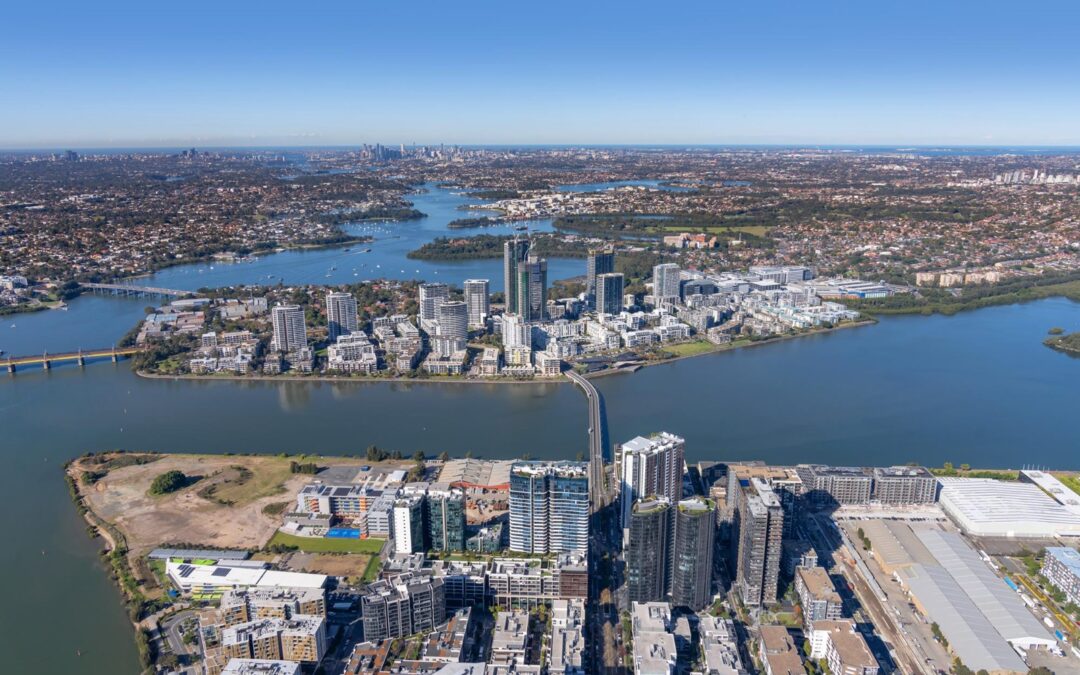
Australian urban growth in 2026 is being shaped by four structural forces: transit-oriented development (TOD) clustering density around rail and metro nodes, mixed-use precincts replacing single-use zoning, mandated sustainability standards (Green Star, NABERS, BASIX), and masterplanned community delivery. Billbergia’s Rhodes, Wentworth Point and Concord Central precincts evidence each force in built form.
9 min read | Industry | Last reviewed June 2026
Australian urban development is evolving faster than at any point since the post-war suburban expansion. Four structural forces, transit-oriented development, mixed-use precincts, mandated sustainability, and masterplanned delivery, are reshaping how and where cities grow. This guide explains each, with built examples from Billbergia’s Sydney and Brisbane portfolio.
The four forces reshaping Australian cities
Australian cities are growing under the pressure of population growth, the National Housing Accord supply targets, and major infrastructure investment. The development response is shaped by four structural forces that consistently appear across Sydney and Brisbane:
| Force | What it changes | Billbergia example |
|---|---|---|
| Transit-oriented development | Density clusters near transport nodes | Rhodes Central (rail + ferry) |
| Mixed-use precincts | Residential, retail, commercial integrated | Concord Central masterplan |
| Mandated sustainability | Green Star, NABERS, BASIX compliance | Sitewide ESD across portfolio |
| Masterplanned delivery | Staged, coordinated community building | Rhodes Bay Masterplan |
Transit-oriented development (TOD)
Transit-oriented development concentrates higher-density residential and mixed-use development within walking distance (typically 400 to 800 metres) of major public transport nodes. It is the dominant strategic planning model for Sydney and Brisbane growth in 2026.
The rationale is consistent: reducing car dependence, supporting walkable neighbourhoods, and aligning density with the infrastructure capacity to support it. CoreLogic 2026 data shows apartments within 400 metres of metro stations command a 15 to 25 percent premium against equivalent stock 800 metres away.
Billbergia’s Rhodes Central sits adjacent to Rhodes Station on the T9 Northern Line with direct rail to the Sydney CBD plus Parramatta River ferry access, a textbook TOD location combining heavy rail and water transport within the masterplanned precinct.
Mixed-use precincts vs single-use zoning
The 20th-century planning model separated land uses: residential here, commercial there, retail somewhere else. The contemporary model integrates them. Mixed-use precincts allow residents to meet daily needs within walking distance, activate streets across more hours of the day, and improve commercial viability through resident foot traffic.
The benefits are practical:
- Walkable access to retail, dining and services
- Reduced car dependence and shorter commutes
- Street activation across daytime and evening
- Stronger sense of community and place
- Better commercial tenancy viability from built-in foot traffic
Mandated sustainability standards
Sustainability has shifted from a marketing differentiator to a regulatory baseline. The key standards applying to Australian residential development in 2026:
| Standard | What it measures | Status |
|---|---|---|
| BASIX (NSW) | Water, energy, thermal comfort | Mandatory for residential |
| Green Star (GBCA) | Whole-building sustainability | Voluntary, increasingly expected |
| NABERS | Operational energy and water | Voluntary, common on commercial |
| AASB S2 | Climate-related financial disclosure | Mandatory for larger entities from 2025 |
At Billbergia, sustainability is embedded from concept through completion: solar photovoltaics, rainwater capture and reuse, thermal-buffer landscaping, and energy-efficient building services are standard inclusions across the portfolio.
Masterplanned community delivery
A masterplanned community is a large-scale development delivered in stages under a single integrated plan, combining residential, retail, recreation, parks and community infrastructure. Masterplanning allows public amenity to be delivered alongside private residential stages, rather than retrofitted afterwards.
Billbergia masterplanned communities include:
- Rhodes Bay Masterplan: ongoing waterfront residential, mixed-use, parks and the Rhodes Recreation Centre
- Concord Central: $2.2 billion masterplanned community at 1 King Street Concord West
- Wentworth Point: integrated residential community adjacent to Sydney Olympic Park, including Marina Square retail
Infrastructure as the anchor for growth
Major infrastructure projects anchor where urban growth concentrates. Developers align project pipelines with infrastructure timelines because transit and amenity access drive both end-user demand and long-term capital growth. The infrastructure shaping Sydney and Brisbane growth through 2030:
- Sydney Metro West: connecting Greater Parramatta to the Sydney CBD, with stations through Sydney Olympic Park, Five Dock and Pyrmont
- Western Sydney International Airport: opening late 2026, anchoring the Aerotropolis
- Sydney Metro City and Southwest: Crows Nest, Victoria Cross and Barangaroo stations
- Brisbane Cross River Rail: reshaping inner Brisbane transit capacity ahead of the 2032 Olympics
Frequently asked questions
Four structural forces: transit-oriented development, mixed-use precincts, mandated sustainability standards (Green Star, NABERS, BASIX), and masterplanned community delivery. Population growth, National Housing Accord supply targets, and infrastructure investment underpin all four.
Transit-oriented development concentrates higher-density residential and mixed-use development within walking distance (typically 400 to 800 metres) of major public transport nodes such as rail stations, metro stations and ferry terminals. It reduces car dependence and is the dominant strategic planning model for Sydney and Brisbane growth in 2026.
Mixed-use precincts integrate residential, retail, commercial and community uses in a single planned area, allowing residents to meet daily needs within walking distance. They support walkable neighbourhoods, activate streets across more hours of the day, and align with NSW and Queensland planning frameworks favouring compact, connected cities.
Key standards include Green Star (GBCA design and as-built ratings), NABERS (energy and water performance), and BASIX (NSW Building Sustainability Index, mandatory for residential). From 2025, climate-related financial disclosure under AASB S2 adds a corporate sustainability transparency layer for larger developers.
A masterplanned community is a large-scale development delivered in stages under a single integrated plan, combining residential, retail, recreation, parks and community infrastructure. Examples include the Rhodes Bay Masterplan and the $2.2 billion Concord Central masterplan.
Major infrastructure projects (Sydney Metro West, Western Sydney International Airport, the Bradfield CBD) anchor where growth concentrates. Developers align pipelines with infrastructure timelines because transit and amenity access drive demand and capital growth. Apartments within 400 metres of metro stations command a 15 to 25 percent premium.
Billbergia delivers masterplanned, transit-oriented, mixed-use communities through an integrated developer-builder model. Active and completed precincts include Rhodes Central and the Rhodes Bay Masterplan, Wentworth Point, Concord Central ($2.2 billion), and Chatswood Grand Residences.
Help others by sharing this guide.
Worked with Billbergia? Help others by leaving a review.
Explore Billbergia’s communities
From Rhodes to Wentworth Point to Concord Central, Billbergia delivers transit-oriented, masterplanned, mixed-use communities across Sydney and Brisbane.
Information current as of June 2026. Sources: Greater Cities Commission, Transport for NSW, Green Building Council Australia, NABERS, NSW Planning Portal, CoreLogic, and Billbergia project documentation. General industry commentary, not financial or property advice.