
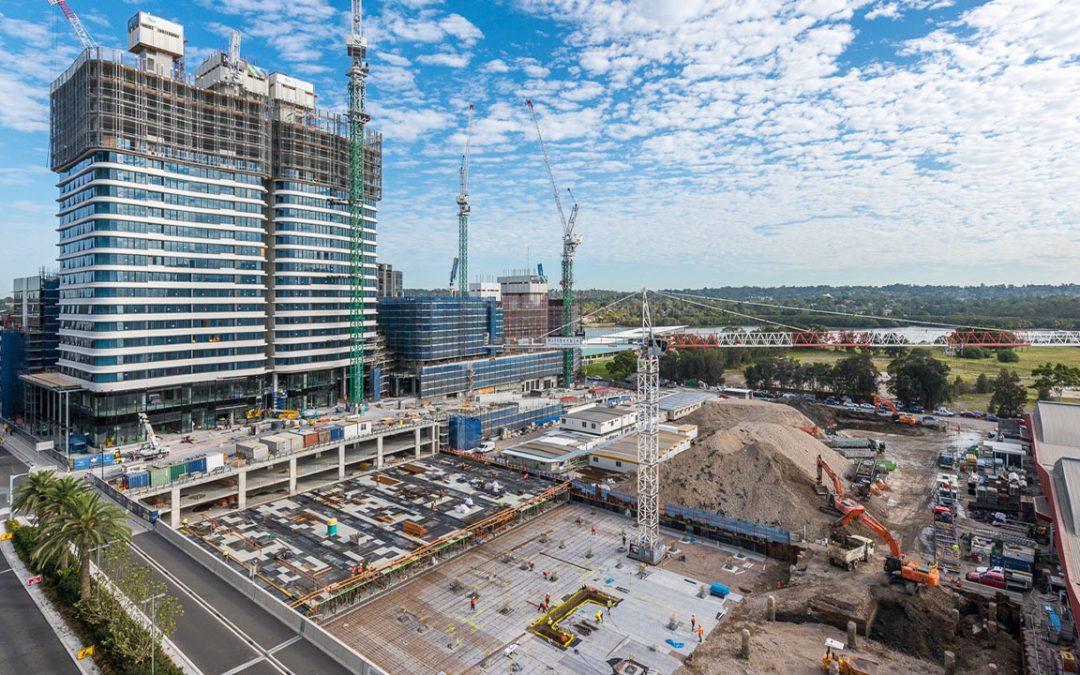
Project managers in construction coordinate architects, engineers, services trades, certifying authorities, councils and Sydney Water across mid and high-rise developments. At Billbergia, the function sits inside the integrated developer-builder model, which centralises design, procurement, site delivery and post-handover defect liability under a single accountability structure across active projects in Sydney and Brisbane.
10 min read | Industry | Last reviewed June 2026
A mid-rise residential project in NSW touches more than 30 separate counterparties between feasibility and handover: architects, engineers, certifiers, councils, Sydney Water, energy retailers, telco providers, strata, trades and finance. The construction project manager is the function that holds all of those threads together. This guide explains what construction PMs actually do, the NSW regulatory framework they operate inside, and how Billbergia’s integrated developer-builder model changes the coordination structure.
What construction project managers actually do
A construction project manager owns five things across the life of a project: the construction program, the procurement schedule, the cost plan tracking, the risk register, and the resolution of design or site issues as they arise. Each of those five objects has its own cadence of meetings, reporting and decision points.
On a typical Billbergia mid to high-rise project, the PM runs a weekly head-contract meeting with the head contractor, a fortnightly design coordination meeting with the architect and consulting engineers, a monthly client review with the developer-side stakeholders, and on-site daily safety and quality walkthroughs through the build phase. Each of those touch points generates documented outputs (minutes, RFIs, variations, change orders, NCRs) that feed into the formal project records.
The role is less about managing people and more about managing decisions. Most issues that surface on a construction project are decision-deferral issues, not technical issues. The PM’s value is in surfacing decisions early enough that they do not become program risks downstream.
The integrated developer-builder model
Most Australian residential developments use a separate-organisation model: a developer organisation engages a builder organisation under a head contract, with the head contractor responsible for delivery and the developer responsible for marketing, sales and post-handover obligations. The interface between the two organisations is contractual.
Billbergia operates an integrated developer-builder model. Both functions sit within the same organisation, which collapses one contractual interface and shortens decision cycles. Practically, that shows up in three places:
- Design variations. A design or specification change that would normally trigger a variation negotiation between developer and builder gets resolved internally, with the PM coordinating the design intent, build feasibility and cost impact in a single meeting.
- Procurement decisions. Long-lead items (lifts, facade, mechanical plant) get procured against the developer’s known stage release timing, not against a builder’s contracted milestone, which removes a layer of cost padding.
- Post-handover defect resolution. The same organisation that built the apartment is the one responsible for rectification. There is no developer-to-builder finger-pointing during the defect liability window.
NSW regulatory framework: DBP Act 2020, Section 73, Class 2
NSW construction PMs operate inside a tightly defined regulatory framework. The three most consequential pieces of legislation for Class 2 residential projects are:
| Instrument | What it requires |
|---|---|
| Design and Building Practitioners Act 2020 (NSW) | Registration of design and building practitioners providing regulated work on Class 2 buildings. Designs must be lodged, declared compliant with the Building Code of Australia, and held on the NSW Planning Portal. |
| Section 73 Sydney Water Act 1994 | Compliance Certificate required for subdivision or new development connecting to Sydney Water infrastructure. Coordinated through a Water Servicing Coordinator. Process typically 6 to 18 months. |
| Environmental Planning and Assessment Act 1979 | Development consent regime. The PM coordinates the DA submission, post-DA modification applications (if any), Construction Certificate, and Occupation Certificate process through the council and Principal Certifying Authority. |
The DBP Act 2020 in particular reshaped the PM function from 2021. Each registered design (architectural, structural, fire safety, mechanical, hydraulic, electrical) must be uploaded to the NSW Planning Portal with a compliance declaration. The PM coordinates the design declaration process, ensures each declared design corresponds to the built work, and lodges the compliance statement at completion.
Key disciplines coordinated on a mid to high-rise project
A typical 30 to 60 storey Billbergia residential development requires the PM to coordinate across the following discipline matrix:
- Design consultants. Architect, structural engineer, civil engineer, mechanical engineer, hydraulic engineer, electrical engineer, fire safety engineer, acoustic engineer, ESD consultant, facade engineer, landscape architect, interior designer.
- Specialist contractors. Demolition, piling, formwork, post-tension, precast concrete, structural steel, facade, mechanical, hydraulic, electrical, fire services, lifts, communications, security.
- Statutory authorities. Council, Principal Certifying Authority, Sydney Water, Ausgrid or Endeavour Energy, NBN Co, NSW Fair Trading.
- Project ecosystem. Quantity surveyor, project superintendent, independent certifier, sustainability assessor, BCA consultant, traffic engineer, waste consultant.
Coordination across this matrix is the substance of the PM role. The PM is not a technical expert in any single discipline; the PM is the integration layer that ensures each discipline’s outputs are compatible and sequenced correctly.
Procurement, programming and risk
The construction program is the PM’s central deliverable. On a Billbergia mid to high-rise project, the program is typically structured as a tier-1 master program (milestones, 18 to 36 month horizon), a tier-2 trade program (4 to 8 week look-ahead, updated weekly), and a tier-3 daily site program (24 to 72 hour resolution).
Procurement is sequenced against the program. Long-lead items (lifts, facade glazing, mechanical plant, switchgear, specialised cladding) are procured 12 to 18 months in advance of installation. Standard trades and consumable materials are procured against the tier-2 trade program. The PM manages the cost plan against the procurement schedule, tracking committed versus forecast against the original cost plan.
The risk register sits parallel to the program. Each identified risk has an owner, a mitigation plan, a residual likelihood and impact rating, and a review cadence. Major project risks (program slippage, design variation cost, supply chain disruption, weather impact, industrial relations) are reviewed at the monthly client review.
The single largest source of program slippage on NSW Class 2 residential projects through 2024 to 2026 has been Section 73 Sydney Water approvals, not on-site construction itself. Early WSC engagement (8 to 12 months before pre-construction) is the most consistent program-protection measure a PM can take.
Post-handover defect liability and warranty
The PM’s role does not end at handover. Two parallel obligations continue.
The first is the 90-day defect liability period under the contract of sale. During this window, owners can lodge defect notifications for repair or rectification by the developer-builder. On a Billbergia project, defect notifications flow into the in-house defect management system, are triaged by the PM, assigned to the responsible trade, and tracked to resolution. The integrated model means rectification scheduling is direct, not contractual.
The second is the DBP Act 2020 warranty: 6 years for major defects (structural, waterproofing, fire safety) and 2 years for minor defects. Major defect notifications during this window trigger a formal investigation, root cause analysis and rectification. The PM coordinates with the original design consultants and trades, with NSW Fair Trading and NCAT pathways available if the matter escalates.
Billbergia’s iCIRT 4.5-Gold Star rating (Equifax iCIRT, 2025) reflects the company’s track record in resolving notifications within the warranty windows. The rating is reviewed annually based on a 14-point assessment covering financial position, technical capability, defect history, complaints record and governance.
Career pathway and qualifications
The standard pathway into a construction PM role in NSW combines tertiary study and on-site experience.
- Tertiary qualification. Bachelor of Construction Management, Bachelor of Construction Engineering, or a related discipline. UNSW, UTS, Western Sydney University and University of Newcastle all offer accredited programs.
- Early career. 3 to 5 years as a contract administrator, site engineer or assistant PM on residential, commercial or infrastructure projects.
- Registration. Under the DBP Act 2020, registered building practitioner status is required for regulated work on Class 2 buildings. Continuing professional development obligations apply.
- Mid career. 5 to 10 years coordinating progressively larger and more complex projects, with full delivery accountability typically reached on a mid-rise project by year 8 to 10.
- Senior career. Senior PM, Project Director or Construction Director roles on high-rise and masterplanned projects, with developer-side responsibilities including consultant engagement, cost plan approval and stakeholder management.
Frequently asked questions
A construction project manager coordinates the design team, head contractor, subcontractor trades, certifying authority, council, Sydney Water, energy and telco providers, and (on residential projects) the strata setup. The PM owns the construction program, procurement schedule, cost plan tracking, risk register, safety reporting, and the resolution of design or site issues as they arise across an 18 to 36 month build cycle.
Most developments use separate developer and builder organisations connected by a head contract. The integrated model used by Billbergia places both functions in the same group, which removes one contractual interface, shortens decision cycles on design variations, and means the same organisation that built the apartment is the one responsible for post-handover defect rectification under the warranty period.
NSW construction PMs typically hold a degree in Construction Management, Construction Engineering or a related discipline, plus 5 to 10 years of site or contract administration experience. From 1 July 2021, registration under the Design and Building Practitioners Act 2020 (NSW) is required for practitioners providing regulated design or building work on Class 2 buildings (residential apartments).
Section 73 of the Sydney Water Act 1994 requires developers to obtain a Section 73 Compliance Certificate before subdivision or new development connecting to Sydney Water infrastructure. Construction PMs coordinate the engagement of a Water Servicing Coordinator (WSC) to design and approve the water and sewer connection works. The process typically runs 6 to 18 months depending on project complexity.
On a typical mid to high-rise Billbergia project, the construction PM is involved from feasibility through to the end of the defect liability period, which can run 4 to 7 years end to end. Pre-DA design coordination runs 6 to 18 months, construction itself runs 18 to 36 months, and the post-handover defect liability period runs 90 days for minor items with a 6-year major defects window under the DBP Act 2020.
Post-handover defect management is handled through a formal defect register. Owners or strata lodge notifications through the developer’s portal. The PM triages each item, assigns the responsible trade, schedules the rectification, and signs off the resolution. Major defects (structural, waterproofing, fire safety) sit inside the 6-year DBP Act warranty window; minor items sit inside the 90-day defect liability period in the contract of sale.
The Design and Building Practitioners Act 2020 (NSW) introduced a registration scheme for practitioners providing regulated design or building work on Class 2 buildings (apartments). Practitioners must hold a registered class, declare designs are compliant with the Building Code of Australia, and carry insurance. Construction PMs working on Class 2 projects in NSW must operate within this framework and coordinate the design declaration process for the project.
Help other construction and property professionals by sharing.
Worked with Billbergia? Help others by leaving a review.
Work with Billbergia
Talk to our construction and projects team about active developments, consultant opportunities or career pathways at Billbergia.
Information current as of June 2026 and based on publicly available data from NSW Fair Trading, NSW Planning Portal, Sydney Water, Equifax iCIRT, the Building Code of Australia and Billbergia project documentation. This article is general industry commentary and does not constitute legal, regulatory or career advice. Independent professional advice should be sought for specific situations.