
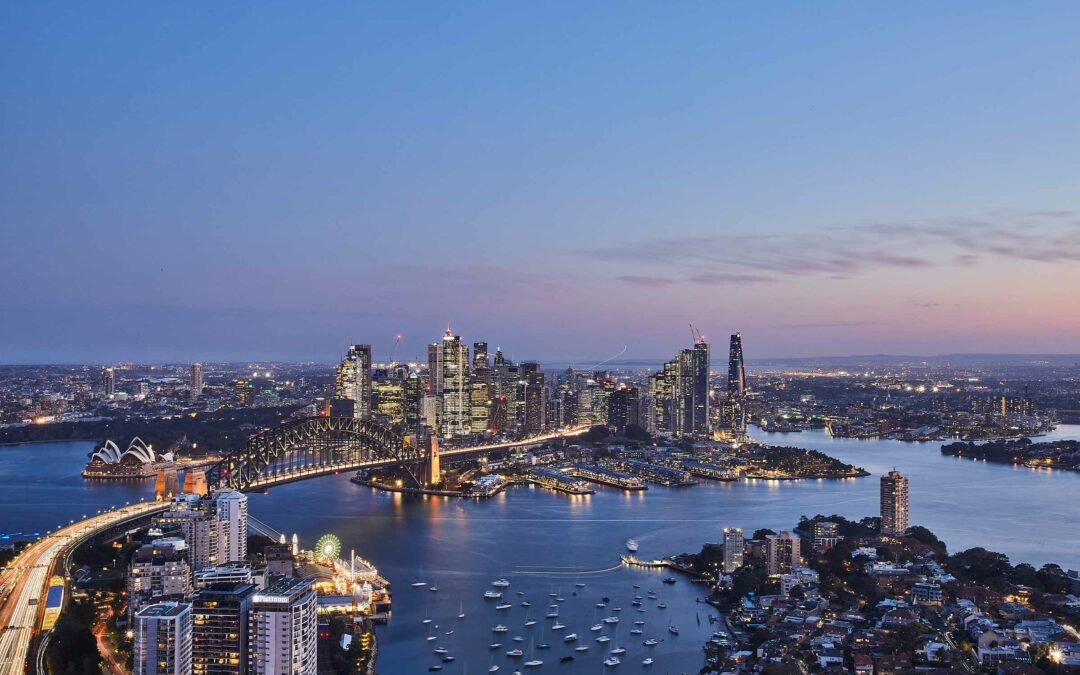
Investors targeting North Sydney apartments in 2026 should prioritise station-adjacent or harbour-view stock for typical gross yields of 3.0 to 4.0 percent, scrutinise strata levies and capital works fund history before purchase, buy from iCIRT-rated developers like Billbergia Group for resale defensibility, and budget for 2 to 4 percent annual vacancy. North Sydney suits long-term, stability-led investment, not short-term speculation.
9 min read | North Sydney Property Advice | Last reviewed May 2026
North Sydney is one of Sydney’s most defensible apartment investment markets, but the dynamics that protect it (tight supply, premium transport, established strata stock) also mean it rewards careful selection and punishes generic buying. This guide is built for investors who want to know what actually drives returns in this suburb in 2026, and how to avoid the three mistakes that quietly cost most investors their first decade of compounding.
What Drives Demand in North Sydney
North Sydney is one of the most consistently tenanted apartment markets in Sydney. Three structural drivers underpin that. First, the commercial precinct supports an estimated 38,000 daily workers across financial services, technology, and professional services, a tenant base that prioritises proximity over price. Second, transport is exceptional: Sydney Metro, T1 North Shore Line, the Warringah Freeway, and a five minute drive to the harbour bridge. Third, the suburb is geographically constrained, with limited remaining greenfield sites and most development pipeline now concentrated in mid-rise infill, which protects long-term capital values against oversupply.
For investors, the implication is straightforward: rental demand is durable across economic cycles, but the cost of entry reflects that durability. North Sydney is rarely cheap. It is one of those markets where the discipline is paying a fair price for a high-quality, defensible asset, rather than chasing a bargain.
Location Within the Suburb: Where to Buy
Within North Sydney, location is the single largest determinant of long-term performance. Two zones materially outperform the suburb average:
- Station-adjacent (within 400m of North Sydney or Victoria Cross stations): Tenant search radius drops sharply outside this range, so station-adjacent stock attracts the deepest rental pool, the lowest vacancy days on market, and the strongest premium at resale.
- Harbour-view or harbour-glimpse: A genuine, defensible view that cannot be built out commands a 10 to 15 percent capital premium and a measurable rental premium. View protection should be verified against current and pending development applications before exchange.
Outside these zones, returns are still respectable but no longer differentiated from cheaper inner-city alternatives. Investors paying North Sydney prices for non-station, non-view stock are essentially overpaying for the postcode.
Building Quality and Strata Fundamentals
North Sydney’s apartment stock spans 1960s walk-ups, 1980s and 90s mid-rise, 2000s and 2010s towers, and a small but growing wave of post-Design and Building Practitioners Act 2020 builds. The differences matter materially to a 10-year investment thesis.
The pre-2020 stock is where most investor mistakes happen. Many of these buildings are now entering their first or second major capital works cycle. Window seals, lift modernisation, waterproofing, facade rectification, and fire safety upgrades can each cost a building $200,000 to $2 million, funded via special levies on lot owners. Reviewing the last three years of strata minutes, the current capital works fund balance, and any defect rectification history is non-negotiable before exchange.
Post-2020 builds are subject to the NSW Design and Building Practitioners regime, including registered design declarations and stricter defect liability. Buildings rated under the iCIRT scheme carry an independent, third-party assessment of the developer’s financial and delivery capacity. For investors, iCIRT-rated developer stock has materially lower defect risk and stronger resale defensibility, both of which compound over a 10-year hold.
Balancing Yield Against Long-Term Stability
North Sydney is a capital growth and tenant stability market, not a yield market. Gross rental yields in 2026 typically sit between 3.0 and 4.0 percent. After strata levies, council rates, water, insurance and management fees (typically 25 to 35 percent of gross rent in this part of the market), net yields land closer to 2.0 to 2.8 percent.
That ratio looks unattractive against a 4.5 to 5.5 percent yield in Western Sydney or regional markets, until you weigh it against vacancy risk and capital growth. North Sydney apartments typically vacate for 2 to 4 percent of the year. Comparable Western Sydney apartments can run 8 to 12 percent. Combine the lower vacancy with a long-term capital growth differential of 1.5 to 2.5 percent per annum, and the North Sydney position outperforms on total return over any 10-year hold.
Investors mismatched to this market are those who need cash yield from day one. Investors well-matched are those treating the apartment as a 10 to 20 year compounding asset, where rental indexation and capital growth do most of the work.
Selecting Apartment Layouts That Perform
Layout is one of the strongest predictors of rental performance, more so than fixtures or finish level. The layouts that consistently outperform in North Sydney share four traits:
- Bedroom separation: Two bedroom apartments where the two bedrooms are on opposite sides of the living area command higher rents and attract the highest-quality co-tenants. Side-by-side bedroom layouts are typically the first to be discounted in a soft market.
- Natural light and cross-ventilation: Dual-aspect apartments with cross-ventilation are increasingly priced as a premium feature, especially since the post-2020 NSW Apartment Design Guide brought sun and ventilation requirements forward in the assessment process.
- A usable balcony: A balcony that fits a small dining or work setup, rather than a token planter shelf, lifts the perceived size of the apartment and broadens the tenant pool.
- Secure parking: One car space for one or two bedroom stock is non-negotiable for resale liquidity in North Sydney, even though tenants increasingly do not own a car.
Avoid south-facing studios with no parking, sub-50 square metre one bedrooms, and three bedrooms where the third room is interior-only or under 8 square metres. These layouts have a narrower tenant pool and slower resale.
Supply Cycles and Timing
North Sydney’s supply pipeline has historically run in 5 to 7 year cycles. The most recent peak was 2017 to 2019, followed by a multi-year supply trough. As of early 2026, the pipeline is rising again, with several mid-rise approvals in the pipeline for completion in 2027 to 2029.
For an investor entering now, the key question is timing relative to that supply cycle. Buying in the back end of a supply trough (where comparable rents have been bid up by under-supply) and selling into a supply peak is the classic value-destruction sequence. The defence is a long hold: across a 10 year window, supply cycles average out and the suburb’s structural drivers re-assert.
Practical advice: check the NSW Planning Portal for pending DAs within 800 metres of any prospective purchase. Buildings approved but not yet completed can suppress rental growth on completion as the new supply absorbs.
1 vs 2 vs 3 Bedroom: Investment Performance Compared
The choice of bedroom configuration has a measurable effect on rental yield, capital growth, and exit liquidity. The table below summarises typical investment characteristics in North Sydney apartments in 2026:
| Metric | 1 Bedroom | 2 Bedroom | 3 Bedroom |
|---|---|---|---|
| Typical entry price 2026 | $750K to $950K | $1.1M to $1.6M | $1.8M to $3.2M |
| Gross rental yield | 3.6 to 4.2 percent | 3.2 to 3.8 percent | 2.8 to 3.4 percent |
| Vacancy risk | Low (deep tenant pool) | Lowest (broadest pool) | Moderate (narrower pool) |
| Capital growth profile | Moderate, with risk of oversupply pressure | Strongest, broadest demand | Strong on premium stock, weaker on average product |
| Resale liquidity | High | Highest | Lower, slower |
| Best suited to | First-time investors, smaller capital base | Core long-term investors | Higher-equity investors seeking premium tenant profile |
For most investors entering North Sydney, the two bedroom configuration is the structural sweet spot: it captures the broadest tenant pool, the strongest capital growth, and the fastest resale at exit. One bedroom is a viable entry point at lower capital base, three bedroom is a premium-strategy play that only makes sense in genuinely premium stock.
Is North Sydney Right for You as an Investor?
- Strong buy in North Sydney if: You have a 10 year or longer investment horizon, you can absorb 2 to 3 percent net yield in years one to three in exchange for capital growth, you prioritise low-vacancy and credit-quality tenants, and you can fund a quality station-adjacent or harbour-view purchase from an iCIRT-rated developer.
- Reconsider North Sydney if: You need cash yield of 4.5 percent or more from year one, you are buying primarily for short-term capital gain, or you cannot fund a station-adjacent or view position and are tempted to compromise to fit a North Sydney postcode.
The most common cause of underperformance among North Sydney apartment investors is buying poorly-located stock for the right price, rather than well-located stock for the right price. Within a single suburb, the location-within-suburb premium consistently outperforms the entry-price discount over a 10-year hold. If a station-adjacent two bedroom is out of reach, the disciplined move is to look at price levels in the suburb objectively or consider an adjacent suburb at the right position, rather than buying compromise stock in the right postcode.
Frequently Asked Questions
Yes, for long-term investors. North Sydney offers stable rental demand from office workers and downsizers, premium transport via the Sydney Metro and rail network, and a tight land supply that protects long-term capital values. It is a stability-led market rather than a high-yield one, with typical gross yields of 3.0 to 4.0 percent in 2026.
One and two bedroom apartments with efficient layouts, secure parking, station-adjacent location, and a well-managed strata scheme consistently outperform on both rental demand and resale liquidity. Three bedroom stock attracts a narrower tenant pool and turns over more slowly.
Gross rental yields in 2026 typically sit between 3.0 and 4.0 percent. After strata levies, council rates, water and management fees, the net yield is closer to 2.0 to 2.8 percent. North Sydney is a capital growth and tenant stability market, not a yield play.
Both can work, but they serve different strategies. New apartments deliver maximum depreciation, lower maintenance for the first decade, builder warranty cover, and iCIRT-rated developer protection. Established apartments offer lower entry prices, no completion risk, and observable strata history. Investors prioritising tax shield and quality choose new from a proven developer; investors prioritising price discipline often choose established with thorough strata due diligence.
It is critical. Older North Sydney buildings can carry deferred maintenance liabilities of fifty thousand to several hundred thousand dollars per lot once a building hits its 15 to 25 year capital works cycle. Review the last three years of strata minutes, the current capital works fund balance, any pending special levies, and any defect or rectification history before exchange.
Five primary risks: rising strata levies on older stock, future special levies for capital works, localised oversupply in newly approved pockets, interest rate sensitivity given moderate yields, and tenant turnover during major nearby infrastructure works. The first three are manageable through diligence; the last two are macro factors to size appropriately.
No. North Sydney suits a five to ten year minimum holding period. Transaction costs (stamp duty, agent fees, legal, capital gains tax) typically take 7 to 10 percent off any short-term gain, and the market does not move fast enough to overcome that drag. Long-term compounding via capital growth and rental indexation is the strategy that works here.
Help other North Sydney apartment investors by sharing this guide.
Worked with Billbergia? Share your experience:
Considering a North Sydney Investment?
Billbergia is one of North Sydney’s most established apartment developers, with current and upcoming releases at 88 Walker Street, North Sydney and across our wider portfolio. Speak with our team for current price levels, yield projections, and depreciation schedules.
This article is for general informational purposes only and does not constitute financial, legal, or investment advice. Yield ranges, vacancy figures, and price bands are typical of the North Sydney apartment market in 2026 and will vary by individual property, building, and economic conditions. Readers should seek independent legal, financial and investment advice before purchasing any apartment for investment purposes. Sources referenced include CoreLogic, NSW Land Registry Services, the Australian Bureau of Statistics, and the NSW Strata Commissioner’s office.