
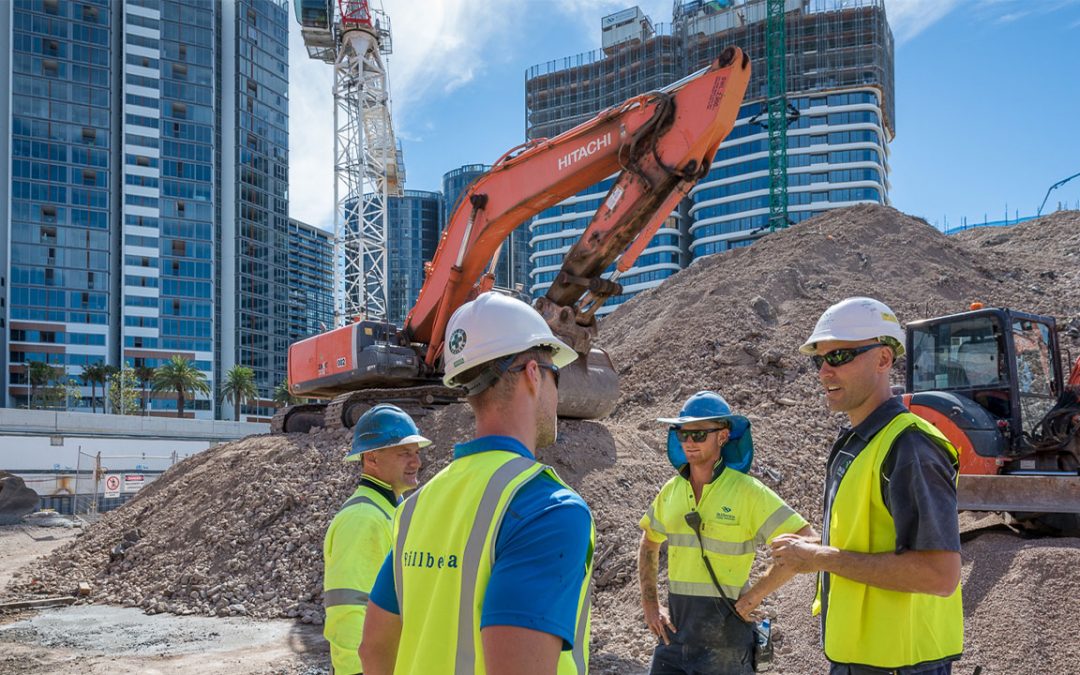
The Billbergia difference in construction project management is the combination of integrated developer-builder accountability, iCIRT 4.5-Gold Star rating (Equifax iCIRT, 2025), and PM leadership held to the same outcome standard across every project. PMs sit inside the developer, not at arm’s length, which means design intent, delivery decisions and post-handover defect resolution all carry through a single chain of accountability.
9 min read | Industry | Last reviewed June 2026
Integrity is a word the construction industry overuses. This article unpacks what it actually means inside Billbergia’s project management function: the four leadership decisions a PM holds accountability for from feasibility through to the 6-year DBP Act warranty, and the structural framework (integrated developer-builder model, iCIRT 4.5-Gold Star, NSW DBP Act 2020) that turns those decisions into durable outcomes.
Integrity as an operating standard, not a slogan
“Integrity-led” is a phrase that has been worn smooth by overuse in the construction industry. Inside Billbergia, it has a concrete operational meaning: the PM is accountable for outcomes after handover, not just to the end of construction. That accountability runs through the contract of sale, the Design and Building Practitioners Act 2020 warranty, and the annual Equifax iCIRT reassessment.
The practical implication is that a Billbergia PM cannot quietly defer a cost or quality decision into the build period and have it become a buyer or strata problem later. The decision either gets made transparently up front, or it gets resolved at developer cost during the warranty period. There is no third option that pushes the consequence onto someone else.
The four leadership decisions a Billbergia PM owns
Across an 18 to 36 month build cycle, a Billbergia PM holds primary accountability for four leadership decisions. Each one carries through to a post-handover consequence, which is what makes the integrity framing operational rather than aspirational.
Decision 1: Carriage of design intent
The design intent agreed at DA stage (apartment layouts, ceiling heights, structural columns, facade treatment, common areas, landscape) must survive into the built work. The PM owns the variation register that tracks any departure from the original design, with sign-off required at each variation. The default position is that buyer-facing specifications do not change after contract exchange.
Decision 2: Transparency of cost movement
Cost variations during the build are recorded against the original cost plan and reported into the monthly client review. Material variations are escalated. The PM does not absorb costs into hidden lines.
Decision 3: Defect rectification through the warranty period
The PM remains the responsible point of contact for warranty defect notifications through the 6-year DBP Act window, not the end of the 90-day defect liability period. This is a longer accountability arc than most PM roles carry in separate developer-builder structures.
Decision 4: Consistency between sold and delivered
The match between what was sold (display suite, brochure, contract specification) and what was delivered (handed-over apartment) is the single most testable measure of PM integrity. Billbergia’s PM accountability includes pre-settlement inspection sign-offs against the contracted specification.
The structural framework: integrated developer-builder + iCIRT
Leadership intent only delivers durable outcomes if the structural framework around it removes the easy escape routes. Two pieces of structure carry the load.
The first is the integrated developer-builder model. In separate-organisation structures, defect or quality disputes can be passed contractually between the developer and the builder after handover. In the integrated Billbergia model, the same organisation built the apartment, sold it, and is responsible for warranty rectification. There is no contractual interface for accountability to fall through.
The second is the Equifax iCIRT rating framework. iCIRT assesses developers across 14 criteria including financial position, technical capability, defect history, customer complaints record and governance. The rating is reviewed annually and is publicly visible at icirt.com. Billbergia holds a 4.5-Gold Star rating (2025). The rating is not a marketing badge; it is an external assessment that reflects how decisions made during the build show up in customer outcomes.
For buyers assessing a developer before contract exchange, the most consequential verification is a current iCIRT rating combined with a track record of completed projects of comparable scale. Both should be checked independently, not taken from a sales brochure.
Handling the cost-versus-quality tension
The single most common point where construction integrity gets tested is the cost-versus-quality decision during the build. Construction costs rise, materials get discontinued, supply chains shift. The temptation is to substitute a lower-cost alternative and absorb the saving into the cost plan.
The Billbergia default position is that specified materials and finishes do not change after contract exchange with buyers, even if substitute products would reduce cost. Where a substitution is genuinely necessary (such as a manufacturer discontinuing a product line), the PM coordinates a like-for-like replacement at developer cost, not buyer cost. The cost plan flexes; the buyer specification does not.
This sounds straightforward but it is operationally hard. It requires the PM to push back on procurement and finance pressures during the build, hold the design and finishes intent as the dominant constraint, and accept margin compression on individual projects when necessary to preserve the buyer specification. It is the practical test of integrity-led project management.
Defect liability and the 6-year warranty window
Three accountability structures run in parallel after handover:
| Structure | Coverage | Duration |
|---|---|---|
| Contract of sale defect liability | Minor defects identified at handover or shortly after | 90 days |
| DBP Act 2020 minor defects warranty | Workmanship and minor component failures | 2 years |
| DBP Act 2020 major defects warranty | Structural, waterproofing, fire safety | 6 years |
The Billbergia PM remains the responsible coordinator across the 6-year window. Defect notifications flow through the in-house defect management system, are triaged by the PM, assigned to the responsible trade, scheduled for rectification, and signed off on resolution. The integrated model means rectification scheduling is direct rather than negotiated across organisational boundaries.
External accountability: iCIRT, NCAT, NSW Fair Trading
Where internal integrity-led processes are not sufficient, external mechanisms apply. Three are particularly consequential for NSW Class 2 residential projects.
- Equifax iCIRT. Annual reassessment, publicly visible, 14-criteria framework. Persistent defect or complaint patterns affect the rating.
- NSW Civil and Administrative Tribunal (NCAT). The pathway for unresolved consumer disputes including warranty claims and contract issues. Decisions are public.
- NSW Fair Trading. The regulator for the building industry under the DBP Act 2020 and Home Building Act 1989. Holds disciplinary powers over registered practitioners.
Each of these mechanisms is consequential because they create durable, external records of how a developer has handled customer outcomes. PM decisions during a build show up in these records years later, which is the structural reason integrity-led project management is not merely a values claim.
Frequently asked questions
Integrity-led construction project management means the PM is accountable for outcomes after handover, not just to the end of construction. Specifically, the PM has carriage of design intent through to construction, transparency of cost variations to the developer and (where contracted) to buyers, defect rectification through the full 6-year DBP Act warranty, and consistency between what was sold and what was delivered.
The Equifax iCIRT rating assesses developers across 14 criteria including financial position, technical capability, defect history, customer complaints record and governance. Billbergia holds a 4.5-Gold Star rating (2025). The rating is reviewed annually and is publicly visible, which means PM decisions on cost, quality and defects sit inside an external assessment framework rather than internal-only governance.
In separate developer-builder structures, defect or quality disputes can be passed between the two organisations after handover. In the integrated Billbergia model, the same organisation built the apartment, sold it, and is responsible for warranty rectification. There is no contractual interface for accountability to fall through.
The default position is that specified materials and finishes do not change after contract exchange with buyers, even if substitute products would reduce cost. Where a substitution is genuinely necessary (e.g. a manufacturer discontinuation), the PM coordinates a like-for-like replacement at developer cost, not buyer cost. The cost plan flexes; the buyer specification does not.
Under the Design and Building Practitioners Act 2020 (NSW), Class 2 buildings carry a 6-year major defects warranty. During this period, the PM coordinates the technical investigation and rectification of structural, waterproofing and fire-safety defect notifications. The integrated model means the same team that built the project owns the warranty response, which materially shortens resolution timeframes.
Accountability runs through three structures: the contractual defect liability period (90 days for minor defects), the DBP Act 2020 warranty (6 years for major defects, 2 years for minor), and the iCIRT annual reassessment, which factors in defect history and customer complaints. NCAT and NSW Fair Trading provide the external escalation pathway if a matter cannot be resolved directly.
The Equifax iCIRT directory at icirt.com publishes current ratings for all assessed developers. Billbergia is listed as a 4.5-Gold Star developer (2025 assessment). The directory is publicly searchable by company name and is the recommended verification source for any buyer assessing developer credentials before contract exchange.
Help other buyers by sharing this guide.
Worked with Billbergia? Help others by leaving a review.
Buy from a developer that stays accountable
Talk to Billbergia’s in-house team about active Sydney and Brisbane developments, current iCIRT rating, and the integrated project delivery model.
Information current as of June 2026 and based on publicly available data from Equifax iCIRT, NSW Fair Trading, the NSW Planning Portal, the Design and Building Practitioners Act 2020 (NSW), and Billbergia project documentation. This article is general industry commentary and does not constitute legal, financial or property advice.