
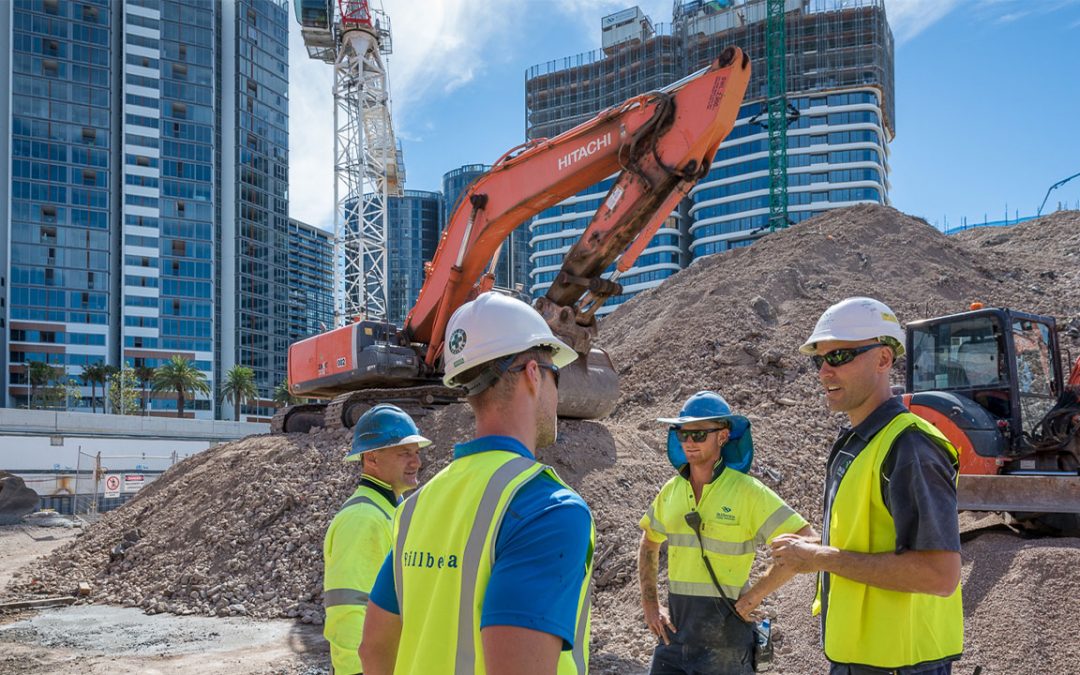
Strong project management and construction management in Australian property is the difference between delivered yield and slipped programs. PMs own the construction program, procurement, cost plan, risk and design intent across an 18 to 36 month build cycle. Integrated developer-builder structures (like Billbergia’s iCIRT 4.5-Gold Star model) materially reduce delivery risk by removing contractual interfaces between design, build and warranty rectification.
9 min read | Industry | Last reviewed June 2026
Strong project management and construction management deliver four measurable outcomes in Australian property: cost certainty, program adherence, design intent integrity, and durable post-handover defect resolution. The integrated developer-builder model removes the contractual interfaces that typically cause delivery risk.
PM vs CM: how the functions differ
Project management and construction management are often used interchangeably. They are not the same function.
| Dimension | Project Management (PM) | Construction Management (CM) |
|---|---|---|
| Scope | Feasibility through to post-handover defect liability | Construction phase site delivery |
| Location | Developer head office, design team meetings | Site office, on the build |
| Owns | Program, cost plan, risk register, design intent | Trade coordination, day-to-day delivery, safety, quality |
| Typical horizon | 4 to 7 years end to end | 18 to 36 months during construction |
Both functions work in parallel during the build. The PM holds the strategic accountability; the CM holds the operational delivery accountability.
The four measurable outcomes of strong PM
Strong PM is measured against four observable outcomes, all of which show up in buyer-facing data after handover.
Cost certainty
Variation from the original cost plan to the final actual cost. Strong PM delivers within 3 to 5 percent variance; weak PM commonly delivers 10 to 20 percent overrun, which gets absorbed by the developer, reduces project margin, and pressures finishes substitution decisions during the build.
Program adherence
Variation from the contracted handover date to the actual handover date. Strong PM delivers within 60 to 90 days variance on an 18 to 36 month program; weak PM commonly delivers 6 to 12 months late, triggering buyer rescission options under the sunset clause.
Design intent integrity
Match between the apartments and common areas sold (display suite, brochure, contract specification) and what was delivered. Strong PM treats the buyer specification as the dominant constraint; weak PM trades buyer specification for cost during the build.
Post-handover defect resolution
Defect notification turnaround time and resolution rate within the 90-day defect liability period and the 6-year DBP Act warranty. Strong PM operates a structured defect register with internal trade scheduling; weak PM relies on ad-hoc escalation.
Where program slippage actually comes from
Most program slippage on NSW Class 2 residential projects through 2024 to 2026 does not come from on-site construction issues. The leading causes:
- Section 73 Sydney Water approvals. Where infrastructure upgrades are required, the WSC process can run 12 to 24 months, blocking pre-construction site works
- Post-DA modifications. Even small design changes trigger council assessment timelines of 6 to 16 weeks per modification
- Long-lead procurement. Lifts, facade glazing, mechanical plant and switchgear have 6 to 18 month lead times globally; supply chain disruption added another 4 to 8 weeks through 2024
- Industrial relations. EBA renegotiations on major sites add intermittent program risk
- Weather impact. Heavy rain windows in late 2024 and 2025 added 3 to 6 weeks to many Sydney concrete pour programs
The single most consistent program-protection measure a PM can take is engaging a Water Servicing Coordinator at feasibility stage (8 to 12 months before pre-construction). Section 73 surprises mid-build are far more expensive than Section 73 risks priced into acquisition.
The integrated developer-builder model
The Billbergia delivery model places developer and builder functions in the same organisation. The structural advantages compound through the project:
- Design variations. Resolved internally instead of negotiated across the developer-builder contract interface
- Procurement. Long-lead items procured against the developer’s stage release timing, not against a builder’s contracted milestones
- Cost plan transparency. The developer sees the actual build cost without builder margin obfuscation
- Defect liability. The same organisation that built the apartment rectifies it under warranty, removing developer-to-builder finger-pointing
- Communication continuity. The same client manager carries through from sales to handover to warranty
iCIRT and the DBP Act 2020 accountability framework
Two external accountability structures matter most for NSW Class 2 residential PM. The first is the Equifax iCIRT rating framework, a 14-criteria annual assessment covering financial position, technical capability, defect history, complaints record and governance. Billbergia holds a 4.5-Gold Star rating (2025), publicly visible at icirt.com.
The second is the Design and Building Practitioners Act 2020 (NSW). The Act introduced practitioner registration, mandatory design lodgement on the NSW Planning Portal, declared design compliance with the Building Code of Australia, statutory duty of care, and clearer warranty periods: 6 years for major defects (structural, waterproofing, fire safety) and 2 years for minor defects. Both structures are external to internal developer governance and create durable accountability records.
Resale value impact of strong delivery
Delivery quality shows up in resale value years after handover. CoreLogic 2026 data suggests a 5 to 12 percent resale premium for apartments in buildings without NCAT defect records versus comparable stock with documented delivery issues. The premium widens on premium-tier stock.
For buyers, the practical implication is that developer selection at contract exchange is the single largest controllable variable in resale value 5 to 10 years post-handover. Verifying the iCIRT rating, integrated developer-builder model and completed project track record is the most consequential pre-purchase due diligence step.
Frequently asked questions
Strong PM delivers four measurable outcomes: cost certainty against the original cost plan, program adherence to the contracted handover date, design intent integrity from DA to handover, and durable post-handover defect resolution under the DBP Act 2020 warranty windows.
Project management is the developer-side function that owns the project across feasibility, design, delivery and post-handover. Construction management is the site-based function within the head contractor (or in Billbergia’s case the integrated builder arm) that owns trade coordination, day-to-day site delivery, safety and quality assurance.
The integrated model places developer and builder functions in the same organisation, removing one contractual interface. This shortens decision cycles on design variations, removes a layer of margin compression, and means the same organisation that built the apartment is responsible for warranty rectification through the 6-year DBP Act window.
Major program risks include Section 73 water servicing approvals (the most common cause of slippage in NSW Class 2 projects 2024-2026), supply chain disruption on long-lead items (lifts, facade, mechanical plant), industrial relations, weather impact, design variation cost during construction, and post-DA modification timelines.
iCIRT (Independent Construction Industry Rating Tool) is the Equifax-operated rating framework that assesses developers across 14 criteria. Billbergia holds a 4.5-Gold Star rating (2025). The rating is reviewed annually and publicly visible at icirt.com.
The Design and Building Practitioners Act 2020 (NSW) introduced a registration scheme for practitioners providing regulated work on Class 2 buildings. Designs must be lodged and declared compliant. The Act introduced statutory duty of care covering 6 years for major defects and 2 years for minor defects.
Properties delivered to specification, on time, with clean defect histories trade at material premiums on resale versus comparable stock with documented delivery issues. CoreLogic 2026 data suggests a 5 to 12 percent resale premium for apartments in buildings without NCAT defect records.
Help other buyers and industry professionals by sharing.
Worked with Billbergia? Help others by leaving a review.
Buy from a developer with verified delivery
Billbergia is rated iCIRT 4.5-Gold Star (2025), operates an integrated developer-builder model, and stands by its product through the full DBP Act warranty.
Information current as of June 2026. Sources: Equifax iCIRT, NSW Fair Trading, NSW Planning Portal, CoreLogic, and the Design and Building Practitioners Act 2020. General industry commentary, not legal, financial or property advice.