
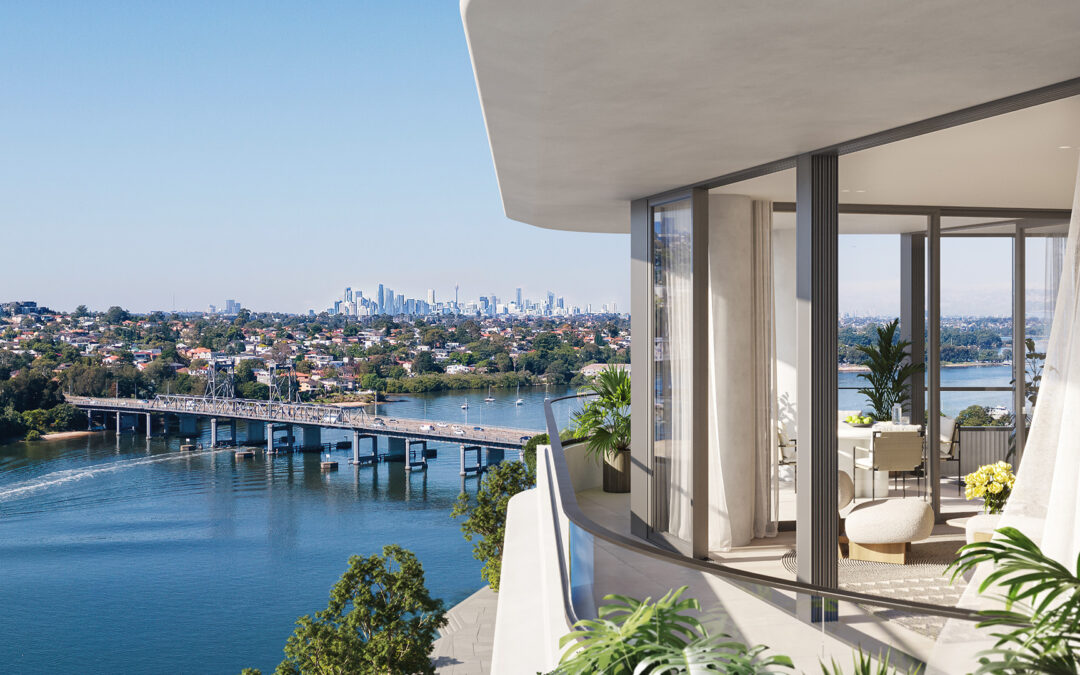
The best Rhodes apartment investments in 2026 are 2-bedroom units in newer iCIRT-rated buildings, priced $880,000 to $1,000,000 with north or east aspect and water or city views. Target gross yield 4.0 to 4.5 percent, hold 7+ years, claim full depreciation via quantity surveyor schedule, and engage a Rhodes-specialist property manager. Avoid older blocks with high special levy risk.
10 min read | Rhodes Investment Strategy | Last reviewed May 2026
Rhodes apartment investment delivers 3.4 to 4.4 percent net yield, 5 to 7 percent long-term capital growth, and one of Sydney’s tightest tenant markets (sub-2 percent vacancy). This playbook covers the practical levers that separate top-quartile Rhodes investments from mediocre ones: building selection, aspect, depreciation, structure, and exit planning.
The Rhodes Investor Thesis
Rhodes (2138) sits in the City of Canada Bay LGA, 18 minutes by train to Wynyard on the T9 Northern line. Three structural factors underpin the investment case in 2026:
- Tenant demand: ABS census shows 75 percent of Rhodes residents rent, with a median age of 32 and high-income occupations. Vacancy rate runs 1.5 to 2.0 percent.
- Master-planned amenity: the foreshore renewal led by Billbergia and other developers has delivered roughly 6,000 apartments with integrated retail, parks, ferry, and gym access.
- Capital growth: 5 to 7 percent compound annual growth over 10 years, with cyclical variation.
Rhodes is not a high-yield play; investors looking for 5+ percent gross yield should look further west. Rhodes is a quality-led capital growth play with reliable rental cash flow, suitable for investors with 7+ year horizons who value tenant demand certainty over headline yield.
For investors comparing Rhodes against other Sydney apartment suburbs, the most relevant peer comparables are Wentworth Point (similar price, slightly weaker transport), Concord (higher price, slightly more amenity), and Burwood (lower price, denser tenant market). North Sydney and Chatswood are aspirationally similar but trade at 25 to 35 percent price premiums.
Building and Precinct Selection
Within Rhodes, three precinct tiers exist for investors. Choosing the right tier is the single most important decision in your investment.
Tier 1: Active master-planned precincts (Billbergia Rhodes Central, Phoenix Apartments, upcoming releases).
- iCIRT-rated developer (Billbergia holds 4.5 Gold).
- Statutory warranties under Design and Building Practitioners Act 2020.
- Full amenity: pool, gym, concierge, retail in the precinct.
- Predictable strata levies; low special levy risk for 5 to 7 years.
- Premium tenant pool; fast lease times (under 14 days).
Tier 2: Recent established stock (2018 to 2022 builds, mainstream Sydney developers).
- Out of new-build statutory defects period but generally still maintained.
- Lower entry price than tier 1 (5 to 10 percent below new).
- Established rental history; verifiable yield.
- Moderate special levy risk.
Tier 3: Older Rhodes stock (pre-2015, smaller blocks, unrated developers).
- Lowest entry price.
- Highest special levy risk (waterproofing, facade, lift renewals coming due).
- Slower lease times (21 to 28 days) and lower rent ceiling.
- No statutory warranties remaining.
Tier 1 is the best risk-adjusted return for most investors; tier 3 should only be entered with deep strata-report due diligence and a clear price discount that reflects the risk profile.
Bedroom Count, Aspect and Floor
Inside the right building, individual apartment selection determines whether you achieve top-quartile or middle-of-suburb returns.
Bedroom count:
| Type | Gross Yield | Vacancy Risk | Resale Pool |
|---|---|---|---|
| 1-bedroom | 4.2 to 4.5% | Low | Investors + singles |
| 2-bedroom | 4.0 to 4.4% | Very low | Wide (singles, couples, owner-occupiers) |
| 3-bedroom | 3.6 to 4.0% | Low to moderate | Families, downsizers |
2-bedroom apartments are the suburb’s sweet spot: broad tenant pool, low vacancy, strong resale liquidity, and yield close to the suburb peak. They account for around 45 percent of Rhodes apartment transactions.
Aspect premium hierarchy:
- North with water view: highest premium, 15 to 20 percent above building average.
- North only: 5 to 8 percent premium.
- East with water view: 8 to 12 percent premium.
- South or west, no view: discount of 0 to 10 percent.
Floor: 1 to 2 percent rent uplift per floor above level 5; 3 to 5 percent for top floor. Lower floors have street noise, higher floors have city or water views and breeze.
Depreciation: The Hidden Yield Multiplier
Depreciation is the single largest controllable variable in Rhodes apartment investment returns. Three rules govern what you can claim:
- New apartments (purchased after 9 May 2017): full capital works (2.5 percent of construction cost per year for 40 years) plus plant and equipment depreciation on appliances, carpets, blinds, hot water systems, air-conditioning at ATO effective lives.
- Existing apartments (purchased after 9 May 2017): capital works only; no plant and equipment depreciation on items installed by a previous owner.
- Both: any new fitout or capital improvement you add post-purchase generates fresh plant and equipment depreciation.
Typical 5-year depreciation on a $900K Rhodes 2-bedroom:
- New build: cumulative $46,400 (year 1 ~$11,500 declining to ~$7,400 in year 5).
- Existing build: cumulative $16,000 (flat ~$3,200 per year).
At a 39 percent marginal tax rate, new builds save approximately $18,100 in tax over 5 years vs $6,240 on existing. That $12,000 difference is real cash flow that compounds. Always engage a quantity surveyor (typical fee $700 to $900) for a property-specific schedule, which is fully tax-deductible in the year incurred.
Ownership Structure and Tax Strategy
The ownership structure for a Rhodes investment apartment affects tax outcomes, gearing flexibility, and estate planning. Four common structures:
Personal name (most common):
- Simplest structure; standard mortgage available.
- Negative gearing offsets personal income tax.
- Family home capital gains exemption available if you later move in.
- 50 percent CGT discount on sale after 12 months.
Family trust:
- Income-splitting flexibility across family members.
- Asset protection from personal creditors.
- Cannot pass losses to individual tax returns (negative gearing benefit lost while loss-making).
- 50 percent CGT discount preserved.
SMSF (Self-Managed Super Fund):
- Uses superannuation savings; tax rate 15 percent on rental income, 10 percent CGT in accumulation, 0 percent in pension phase.
- Limited recourse borrowing arrangement (LRBA) required; lender LVRs lower (typically 60 to 70 percent).
- Strict compliance rules; sole purpose test must be met.
- Suits investors aged 45+ with $300K+ in super.
Joint ownership (spouses):
- Splits rental income and capital gains by ownership share.
- Optimises tax when one spouse is on a lower marginal rate.
- Most flexible for owner-occupier conversion later.
Always consult a structured tax adviser before committing. The wrong structure can cost $15K to $50K over a 10-year hold; the right one can add 1 to 2 percent annualised return.
Property Management and Tenant Selection
Property management is where many Rhodes investors quietly lose 0.5 to 1.0 percent of annual return without realising it. The right manager pays for themselves; the wrong one costs more than their fee.
What a good Rhodes property manager delivers:
- Rent set at the top of the achievable band (not the easy mid-band).
- Lease times under 14 days through pre-marketing before vacancy.
- Tenant screening: rental history, employment, references, NTD check.
- Quarterly inspections with photos.
- Maintenance vendor coordination at competitive rates.
- Annual rent review with market evidence.
Typical fees in Rhodes: 6 to 8 percent of gross rent plus letting fee (1 to 2 weeks rent) and renewal fee. Negotiate the package for landlords with 2+ properties.
Tenant selection in Rhodes: the strong profile is a 25 to 35 year old professional couple or single, employed in CBD or Macquarie Park, with 2+ year rental history and 3+ years employment tenure. Avoid international students on short visas (high turnover) and tenants with patchy NTD records.
The single most important property management decision in Rhodes is not who you hire, but how often you communicate. Investors who speak to their manager quarterly (not just at lease renewal) consistently achieve 2 to 4 percent higher net yield through better rent setting, faster maintenance turnaround, and earlier identification of tenant issues. Treat property management as an active relationship, not a set-and-forget service.
Exit Planning and Common Mistakes
The exit strategy should be defined at purchase, not improvised at year 5. Three common exit paths for Rhodes apartments:
Hold and rent (7 to 10 years): the default for most investors. Compounding capital growth and depreciation deductions deliver the strongest after-tax return over a 7+ year hold. Annual review with your tax adviser optimises the holding period.
Move in (owner-occupier conversion): convert investment to family home; capital gains tax reduces proportionally to time as principal place of residence. Useful for second-home buyers planning to eventually relocate.
Sell at market peak: identify your peak signal (yield compression below 3 percent, days-on-market under 14, building age 10 to 12 years). Selling at peak captures growth before special levy risk increases.
Common mistakes that cost Rhodes investors money:
- Skipping the strata report: a $400 report can reveal $25,000 special levies; the single highest return on due diligence in apartment investment.
- Buying in a small block (under 50 apartments) without checking sinking fund: small blocks have higher per-apartment exposure to common-property repairs.
- Overpaying for poor aspect or low floor: glossy floor plans and renders cannot rescue a southwest-facing low-floor apartment from yielding 0.3 to 0.5 percentage points below building median.
- Self-managing instead of professional management: investors who self-manage typically achieve 4 to 7 percent lower rent and 2 to 3 weeks longer vacancy.
- Underestimating depreciation: not commissioning a quantity surveyor schedule for new builds typically forfeits $5K to $8K per year in deductions.
Billbergia delivers Rhodes apartments across all price points and stages, with iCIRT 4.5 Gold rating and 6,000+ apartments delivered since 1988. For investor-targeted stock in active precincts, see current and upcoming releases via our team or browse the full project portfolio.
Frequently Asked Questions
2-bedroom apartments deliver the best balance of yield, capital growth and tenant demand in Rhodes. Gross yields run 4.0 to 4.4 percent on 2-bedrooms vs 4.2 to 4.5 percent on 1-bedrooms, but 2-bedroom stock has lower vacancy risk (under 14 day average lease) and broader resale appeal across owner-occupiers and couples. 1-bedroom apartments suit yield-focused investors; 3-bedroom apartments lock in family tenants but yield 3.6 to 4.0 percent.
Master-planned precincts deliver the best long-term returns in Rhodes. Active Billbergia precincts (Rhodes Central, Phoenix Apartments, upcoming releases) offer modern amenity, iCIRT 4.5 Gold developer rating, and proven tenant demand. Older infill blocks (pre-2015, fewer than 50 apartments) carry higher special levy risk and slower lease times; investors should be cautious unless price reflects the risk discount.
Five proven yield levers in Rhodes: (1) premium aspect (north or water-facing) commands $40 to $80 per week more than south or no-view, (2) smart locks and integrated wifi can add $20 to $30 per week with young professional tenants, (3) include car space and storage cage in lease, (4) furnish partially (premium bed, sofa) for a 5 to 10 percent rent premium, (5) engage a Rhodes-specialist property manager who knows the precinct’s rent ceiling.
A new 2-bedroom Rhodes apartment ($900K purchase) can claim approximately $46,000 in cumulative depreciation across the first 5 years: capital works at 2.5 percent of construction cost (~$3,500 per year) plus plant and equipment on appliances, carpets, blinds, hot water systems (declining from ~$8,000 in year 1). Engage a quantity surveyor for a property-specific schedule under section 40 of the Income Tax Assessment Act 1997.
Personal name is the default and simplest structure, with the family home capital gains exemption available if you later move in. SMSF works for older investors using superannuation but is restricted to limited recourse borrowing arrangements (LRBA) with smaller LVRs and complex rules. Family trusts offer income-splitting flexibility but lose negative gearing benefits if loss-making. Consult a structured tax adviser before committing.
Minimum 7 years is the standard recommendation, with 10+ years optimal. Transaction costs (stamp duty, agent fees, capital gains tax) typically eat 5 to 7 percent of the asset value at sale. Compounding capital growth at 5 to 7 percent per annum needs 3 to 4 years to cover those costs, then several years more to generate meaningful net return. Long-hold investors consistently outperform short-hold flippers in Rhodes.
Five common mistakes: (1) skipping the strata report on an established apartment, (2) buying in a small block (under 50 apartments) without checking sinking fund balance, (3) overpaying for poor aspect or low floor based on glossy marketing, (4) self-managing instead of engaging a Rhodes-specialist property manager, (5) underestimating depreciation by skipping a quantity surveyor schedule. Each mistake can cost $10K to $50K over a 7-year hold.
Help other Rhodes buyers by sharing this guide with your network.
Worked with Billbergia? Share your experience:
Invest in Rhodes with Billbergia
Rhodes investment-grade apartments from $700K (1-bedroom) to $1.6M+ (3-bedroom premium), with completed stock and off-the-plan releases across active master-planned precincts. iCIRT 4.5 Gold rated; 6,000+ apartments delivered since 1988.
This article is general information only and does not constitute financial, investment, or tax advice. Yield, growth, and depreciation figures are indicative and depend on individual property, lender, market and tax circumstances. Always engage a quantity surveyor, licensed financial adviser, mortgage broker, and structured tax adviser before making investment decisions. Information current as of May 2026; sources include Australian Taxation Office, CoreLogic, NSW Land Registry Services, NSW Strata Commissioner’s office, and Australian Bureau of Statistics.