
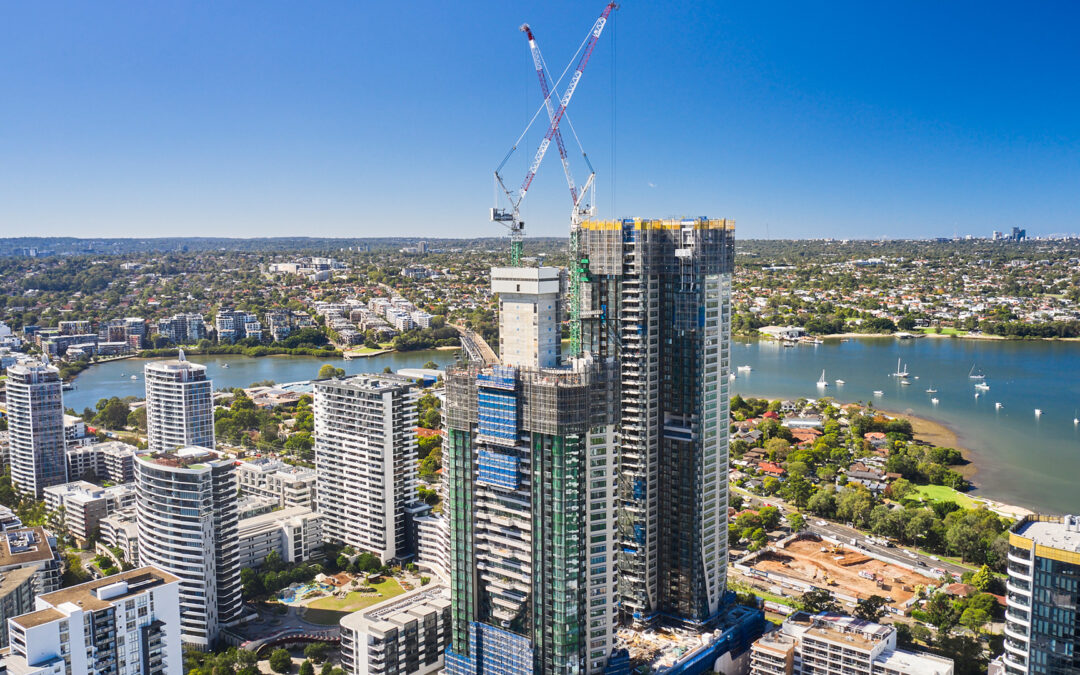
Buying off the plan in Rhodes NSW lets buyers lock in 2026 prices in a tightly-supplied waterfront suburb, access reduced stamp duty on the land component, and secure depreciation benefits of $12,000 to $22,000 per year. Key risks are 18 to 30 month build delays, valuation movement during construction, and developer financial strength, which is significantly reduced by buying from an iCIRT-rated developer like Billbergia Group.
9 min read | Rhodes Property Advice | Last reviewed May 2026
Buying off the plan in Rhodes offers genuine financial and lifestyle advantages, especially in a waterfront precinct where new supply is increasingly tightly controlled, but it carries real risks that need honest assessment before you sign. This guide walks through the pros, the cons, and the four checks that separate confident off-the-plan buyers from the ones who get burned.
What Does ‘Buying Off the Plan’ Mean in Rhodes?
Buying off the plan in Rhodes means purchasing an apartment before construction is complete, sometimes before the first sod is turned on the site. You sign a contract, pay a 10 percent deposit, and settle when the strata plan is registered with NSW Land Registry Services. In Rhodes, off-the-plan purchases typically run with established waterfront developers like Billbergia, which has delivered the Rhodes Bay precinct, Rhodes Central, and several earlier projects in the suburb since the early 2000s.
The construction period for a Rhodes apartment is typically 18 to 30 months, depending on the project. Larger waterfront masterplans with podium retail or community infrastructure can run longer. Throughout that period your 10 percent deposit sits in a trust account, and your contract obligations are fixed against future market movement.
Pros of Buying Off the Plan in Rhodes
1. Lock In 2026 Prices for a Tightly-Supplied Waterfront Suburb
Rhodes is geographically constrained: it sits on a peninsula bordered by Homebush Bay and the Parramatta River. New apartment supply is concentrated in a small number of large masterplanned developments. Locking in a price today against a market that has historically appreciated 4 to 6 percent per annum is a meaningful financial advantage.
2. Reduced Stamp Duty
In NSW, stamp duty on an off-the-plan apartment is assessed on the dutiable value at contract date, which is typically the land component plus any construction already completed. For a $1 million Rhodes apartment, this can mean paying stamp duty on $500,000 to $700,000 of dutiable value rather than the full price, saving $8,000 to $20,000 upfront. First home buyers may also qualify for the NSW First Home Buyer Assistance Scheme on new builds under the value cap.
3. Customisation Options
Buyers who exchange early often have the ability to select kitchen and bathroom finishes, flooring schemes, and appliance packages. In larger Rhodes developments, two or three colour schemes are typically offered. These choices are not available to buyers of completed apartments.
4. Extended Time to Save
The 18 to 30 month construction period gives you additional time to save toward the settlement balance. Instead of a hard 6-week settlement deadline after exchange (typical for an established apartment), off-the-plan buyers can continue saving, reduce the mortgage balance they need to fund, and avoid Lenders Mortgage Insurance if they can reach a 20 percent deposit by completion.
5. Brand New with Builder’s Warranty
Off-the-plan apartments in Rhodes are delivered new, with full builder warranties: six years for major defects, two years for non-structural under NSW Home Building Act warranties. Buildings completed under the post-2020 NSW Design and Building Practitioners Act regime also carry registered design declarations and stricter defect liability for the first ten years.
6. Maximum Depreciation for Investors
New apartments deliver the highest depreciation claims available in Australian residential property. A new Rhodes apartment purchased from Billbergia typically generates a depreciation schedule worth $12,000 to $22,000 per year in the early holding period (combined Division 40 and Division 43 deductions), based on typical Rhodes apartment prices and finish levels in 2026. For an investor on the top marginal tax rate, that is a significant non-cash tax shield.
Cons of Buying Off the Plan in Rhodes
1. Valuation Risk at Settlement
If property values fall during the construction period, the completed apartment may be valued by your lender at less than your contracted purchase price. Your lender will only finance against the lower valuation, and you will need to fund the shortfall from cash savings. This is the single most commonly cited risk in off-the-plan buying and was a real issue for some buyers between 2017 and 2019 when Sydney prices softened mid-build.
2. You Cannot Inspect the Actual Apartment Before Buying
Off-the-plan buyers decide on the basis of floor plans, finishes schedules, material samples, and display suites rather than the apartment itself. There is an inherent gap between the rendered marketing and the delivered product. Quality developers like Billbergia consistently match or exceed their representations, but the gap can be significant with less proven developers.
3. Construction Delays
Construction delays of 3 to 6 months from the original sunset date are common in Sydney apartment projects, driven by council approval timelines, material supply, contractor capacity, and weather. A “completion by Q3 2027” forecast can realistically land Q4 2027 or Q1 2028. NSW sunset clause reform in 2018 reduced developer ability to rescind contracts unilaterally for delays, which is a buyer protection, but the delay itself is still a planning challenge.
4. Deposit Tied Up
The 10 percent deposit sits in a trust account for the duration of construction and earns minimal interest (typically below the cash rate). On a $1 million Rhodes apartment, that is $100,000 sitting idle for 18 to 30 months when it could be invested or offsetting another mortgage.
5. Developer Risk
If a developer becomes insolvent during construction, buyers face refunded deposits and lost opportunity at best, and prolonged legal proceedings at worst. This risk is significantly reduced by buying from an iCIRT-rated developer with institutional backing and a multi-decade completion track record. Verifying a developer’s iCIRT rating before exchange is the single highest-leverage diligence step in off-the-plan buying.
Off the Plan vs Established Rhodes Apartments: Side by Side
Both routes can work for the right buyer. The table below summarises the key differences in 2026:
| Factor | Off the Plan | Established Apartment |
|---|---|---|
| Time to occupy | 18 to 30 months | 6 to 8 weeks from exchange |
| Stamp duty in NSW | Assessed on lower dutiable value, typically $8K-$20K saving | Assessed on full purchase price |
| Depreciation (investor) | Maximum: $12K to $22K/year early years | Limited to capital works only |
| Valuation risk at settlement | Yes, if Sydney market softens during build | None, valuation is current |
| Customisation | Some finishes selectable if early | None, as-is |
| Strata history visible | No, brand new scheme | Yes, can inspect minutes and balance |
| Defect liability | 6 years major / 2 years non-structural | Negotiated case by case |
| Best suited to | Investors seeking depreciation, buyers with patience and savings runway | Owner-occupiers needing immediate occupancy, buyers wanting observable strata |
Is Off the Plan Right for You in Rhodes?
- Strong buy off the plan if: You are an investor seeking depreciation, you want the stamp duty saving, you are buying from a proven iCIRT-rated developer like Billbergia’s Rhodes Bay Masterplan, you have 18 to 30 months before you need to move in, and you can absorb a 5 to 10 percent valuation movement if Sydney softens mid-build.
- Consider an established apartment if: You need immediate occupancy, you are risk-averse about valuations, you want to physically inspect the exact apartment before committing, or you want to inspect strata minutes and capital works fund balance before exchange.
The single highest-leverage risk mitigation in off-the-plan buying is developer selection. Buying off the plan from Billbergia, with over 6,000 apartments delivered across Sydney since 1988 and an iCIRT 4.5-Gold rating, is categorically different from buying from an untested or undercapitalised developer. Verify the iCIRT rating and completion track record before you exchange.
Frequently Asked Questions
Valuation risk and developer financial strength are the two largest concerns. Valuation risk is where the completed apartment’s bank valuation comes in below your contracted purchase price, requiring you to fund the shortfall. Developer risk is mitigated by buying from an iCIRT-rated developer with a long completion track record like Billbergia Group, which has delivered over 6,000 apartments across Sydney since 1988.
The standard deposit is 10 percent of the purchase price, paid on exchange of contracts and held in a trust account until settlement. For a typical 2-bedroom Rhodes apartment priced between $900,000 and $1.2 million in 2026, that is a deposit of $90,000 to $120,000. The balance is paid at settlement when the building is registered.
Construction in Rhodes typically takes 18 to 30 months from exchange of contracts to settlement, depending on the size and complexity of the project. Larger waterfront projects with podium retail or community infrastructure can run to 36 months. Settlement is triggered by registration of the strata plan, not a fixed calendar date, so a 3 to 6 month variance is normal.
In most cases, no. Off-the-plan contracts in NSW typically prohibit assignment or on-sale of the contract without the developer’s written consent. The standard Real Estate Institute of NSW off-the-plan contract has restrictive transfer terms. Check the specific contract you are signing before assuming you can on-sell before completion.
Generally yes, because in NSW stamp duty is assessed on the dutiable value at the time of contract, which for off-the-plan is the land component plus construction already completed. For a $1 million Rhodes apartment, this can mean stamp duty on $500,000 to $700,000 of dutiable value rather than the full price, saving $8,000 to $20,000. First home buyers may also qualify for additional exemptions on new builds under the value cap.
You are in breach of contract and the developer may retain your 10 percent deposit and potentially pursue you for any shortfall if they resell the apartment at a lower price. Maintaining and renewing your finance pre-approval throughout the 18 to 30 month construction period is essential. Most buyers re-apply for formal approval 3 to 6 months before settlement once the building is nearing registration.
For long-term investors, yes, with disciplined selection. Rhodes offers gross rental yields of 3.5 to 4.5 percent in 2026, stronger than North Sydney or Chatswood, with low vacancy (typically 2 to 3 percent) thanks to proximity to Sydney Olympic Park, Macquarie Park, and the Parramatta business district. Capital growth has historically tracked the broader Sydney middle-ring market. The depreciation schedule on a new Rhodes apartment typically delivers $12,000 to $22,000 per year in non-cash tax deductions during the early holding period.
Help other Rhodes buyers by sharing this guide with your network.
Worked with Billbergia? Share your experience:
Considering a Rhodes Off-the-Plan Purchase?
Billbergia has shaped the Rhodes waterfront precinct for two decades, with current and upcoming releases at Rhodes Bay Masterplan and across our wider Sydney portfolio. Speak with our team for current price levels, project timelines, and what’s available off the plan.
This article is for general informational purposes only and does not constitute financial, legal, or investment advice. Yield ranges, price bands, depreciation estimates and stamp duty figures are typical of the Rhodes apartment market in 2026 and will vary by individual property and individual circumstances. Readers should seek independent legal, financial and investment advice before entering into any off-the-plan contract. Sources referenced include CoreLogic, NSW Revenue, NSW Land Registry Services, and the Australian Taxation Office.